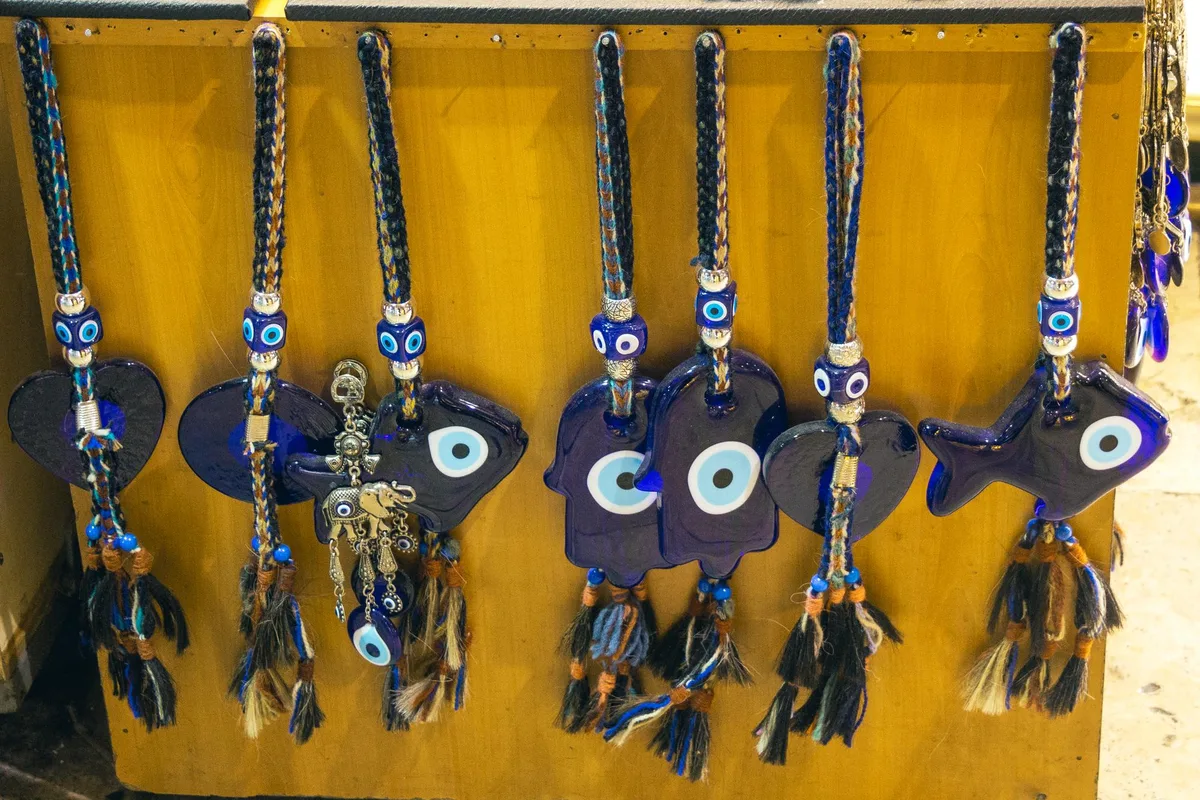
Maybe you have had it hanging at home for years. Maybe your grandmother gave it to you without quite explaining why. Or maybe you are looking for it now because something in your life is not right and someone told you the blue Turkish eye might help. Whatever your reason, there is something important to understand before going on: the blue Turkish eye is not only an ornament. For millions of people in Mexico, Central America and the Caribbean, it is a symbol of protection with very old roots, and its presence in a home or on the body has a concrete meaning.
Where the blue Turkish eye comes from
The popular name is "Turkish eye," but its origin is Mediterranean and Middle Eastern. In Turkey it is called nazar boncuğu. In Greece it is known as matiasma. The Arab world has its own version. All these cultures reached the same conclusion by separate roads: there are gazes that do harm, and a symbol shaped like an eye can intercept that energy before it reaches the person.
When it reached Latin America, it mixed with existing beliefs about the evil eye. The Mexican Indigenous tradition, for example, already recognized the power of the gaze long before any contact with the Mediterranean world. The result is what we know today: a blue and white amulet the Hispanic community in the United States uses with a mix of faith, custom and family memory.
What the color blue stands for
The blue is not decorative. In the spiritual symbolism of several traditions, dark blue and light blue have different functions.
Dark blue
Stands for karma and destiny. It is linked to protection against what comes from outside: envy, loaded gazes, negative intentions from people near or unknown.
Light blue
Is linked to the sky and to peace. In some traditions it is used specifically to protect children, because babies and minors are believed to absorb energy more easily than adults.
The white at the center of the amulet symbolizes purity and light. And the black or darkest inner dot stands for the eye itself: the one that watches and returns what is sent to it.
The evil eye and why the blue Turkish eye exists to stop it
To understand the blue Turkish eye you first have to understand what the evil eye is. It is not mere superstition. It is a belief shared by cultures that never met, which gives it a weight worth taking seriously.
The evil eye happens when someone looks at another person, a child or a business with a particular emotional intensity. It can be conscious envy. It can be excessive admiration. It can be a wish to have what the other person has. That emotional load, according to this tradition, is transmitted and creates an imbalance in whoever receives it.
The symptoms people describe vary. Unexplained crying in babies. Headaches nothing relieves. Deep tiredness with no medical cause. A run of bad news concentrated in a short time. General malaise no doctor can explain precisely.
The blue Turkish eye acts, according to this belief, like a mirror. It returns the negative energy to whoever sent it before it comes into contact with the protected person.
When the blue Turkish eye breaks or gets lost
Many people notice their amulet suddenly cracks, with no apparent blow. In Hispanic folk tradition, this is not read as an accident. It is read as a sign that the amulet did its job: it absorbed something aimed at you and broke in the process.
The same is said when the amulet disappears. If you look for it and cannot find it, some see it as a sign that it was protecting something important and that process is now over.
When this happens, the recommendation within the tradition is clear: do not reuse the broken amulet. Discard it, thank it for its work and get a new one. A broken blue Turkish eye that is kept or glued back together can lose its protective function.
Where to place the blue Turkish eye at home
Position matters. Placing it at random on a shelf is not the same as placing it with intention in the right spot.
- At the entrance of the house, at eye level, because it is the first point of contact between the outside and the home.
- In the room of small children, especially newborns, because they are believed to be more vulnerable to the evil eye.
- In a business, near the register or the customer service point.
- In the area where visitors are received, since that is where the most outside energy enters the space.
What is not advisable is placing it in spaces of deep rest such as the bathroom or places without steady natural light. The amulet works best where there is movement and contact with people.
Blue Turkish eye and Mexican curanderismo: differences that matter
The blue Turkish eye is a passive amulet. It protects while it is present, but it does not act on what already got in. This is an important difference many people do not know.
If someone has been feeling bad for months, if the business already started falling, if the relationship already broke, the amulet alone is not enough. In Mexican curanderismo and other spiritual traditions of Latin America, there is a distinction between prevention and cleansing.
Prevention is done by the amulet. Cleansing requires work. Some people arrive after months of carrying something they do not know how to name: a weight in the body, an energy you feel but cannot describe, a sense that nothing flows. A blue Turkish eye does not resolve that. That requires a cleansing with herbs, prayers and guidance from someone who knows what they are doing.
When the amulet is not enough
The blue Turkish eye was not enough if you are already living through any of these situations: financial losses not explained by your decisions, sudden distance from people close to you for no apparent reason, illnesses the doctor cannot clearly identify, or a persistent feeling of spiritual exhaustion that does not pass with rest.
Those situations are not exclusively spiritual. They can have practical, emotional or medical causes. But if you have already ruled out the obvious causes and the problem persists, then it is worth considering that there is something more.
The difference between a spiritual problem and a medical or emotional one
This point matters. A responsible curandero will tell you directly.
There are situations that need a doctor, not a cleansing. An infection needs antibiotics. Clinical depression needs professional mental health support. A relationship problem that comes from years of broken communication needs dialogue, not amarres.
The signs that point to something spiritual are different: the problem appeared all at once with no visible cause, several fronts fell at the same time (health, money and relationships together), practical solutions do not work even though you do everything right, and you have a persistent inner perception that something external is interfering in your life.
Spiritual work and medical care do not exclude each other. They are done together when they are needed together. Any curandero who asks you to abandon a medical treatment to receive spiritual care is not acting responsibly.
Frequently asked questions
Does the blue Turkish eye work even if you do not believe in it?
The tradition says the amulet works with the energy of the space, not with the person's faith. But the intention with which it is placed and activated does influence its effectiveness. Placing it with awareness and a clear purpose is different from hanging it as decoration without thinking about anything.
Can I give a blue Turkish eye as a gift, or does it only work if I buy it for myself?
It can be given. In fact, in many traditions a blue Turkish eye given with the intention of protecting has more strength than one bought for yourself. What matters is that whoever gives it has a genuine wish to protect whoever receives it.
How many blue Turkish eyes can you have at home?
There is no set limit. Many families have several at different points in the house. What the tradition does recommend is that each one have a specific location and purpose, not that they be grouped in one place without order.
Does the blue Turkish eye protect against witchcraft or work done against you?
It protects against the evil eye and the negative energies generated by gazes or emotions. For direct witchcraft work, the curanderismo tradition holds that something more is needed: a cleansing, specific prayers and in some cases deeper spiritual work.
What do I do with the blue Turkish eye after it breaks?
The most recommended thing is to wrap it in paper or cloth, thank it for its work and discard it outside the house. Do not throw it away inside the home. Some bury it in the ground. The point is to take it out of the space and not use it again.
Is there a difference between the blue Turkish eye and the ojo de venado used in Mexico?
Yes. The ojo de venado is a seed of pre-Hispanic origin used especially to protect babies from the evil eye in the Mexican tradition. It has a different cultural origin from the blue Turkish eye, but both share the same function: intercepting negative energy before it affects the person.
Can the blue Turkish eye be used together with a spiritual cleansing?
Yes, and often that is exactly what is done. The cleansing works on what is already inside: what already got in and created the imbalance. The blue Turkish eye acts as protection going forward, so that what was cleaned does not come back in as easily.
When to seek guidance from a specialist
If you already have the blue Turkish eye, if you have already done what you could on your own and feel the problem persists, the next step is to talk with someone who has real knowledge of spiritual work. Not just anyone who advertises online. Someone with roots in a concrete tradition and years of real practice.
Don Jacinto Nahual is a curandero from Catemaco, Veracruz, a region known for generations of spiritual work in Mexico. He has spent more than 30 years in this practice, with knowledge passed down within his family. He sees people in person by appointment in Los Angeles, Long Beach and Santa Ana, and also gives initial guidance by call or message for those who cannot travel right away. He works in English and Spanish.
His work includes cleansings with herbs and prayers, energetic protection and harmonizing the home. He does not promise immediate results. He does not guarantee instant magic. What he offers is spiritual discipline, faith and strengthening of the spirit, which is exactly what the authentic curanderismo tradition proposes.
If what you are living overwhelms you and you feel you need guidance, the blue Turkish eye was the first step. A conversation with someone like Don Jacinto can be the next.