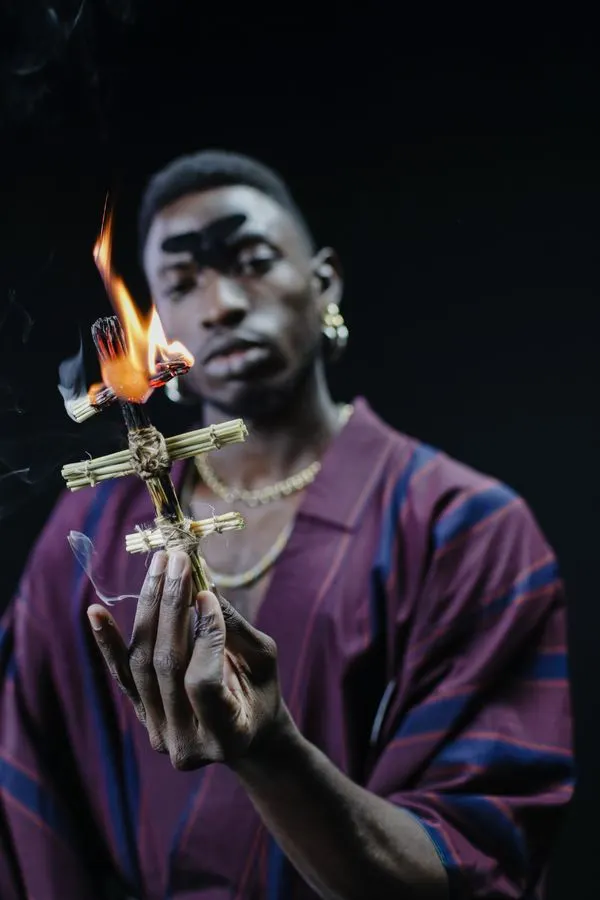
Santeria is a religion. It was born in Cuba when enslaved Yoruba people, forbidden from worshiping their own gods, matched each of them to a Catholic saint and kept praying under a different name. Its formal name is Regla de Ocha, or Lucumí. The popular name means exactly what it says: the religion of the saints.
I am Don Jacinto Nahual, from the curandero tradition of Catemaco, Veracruz. I am not a santero and not a babalawo, and I say that in the first paragraph because plenty of people take the name without the initiation. But the two traditions share something a lot of people recognize on sight: both work through saints. That is why someone who calls me asking about santeria can usually be helped, even when the work we do is not santeria.
Who the orishas are
The orishas are the deities of the Yoruba religion, each paired in Cuba with a Catholic saint. A few every Hispanic family in Los Angeles has heard of:
- Elegguá. Opener of roads, guardian of doors and crossroads. Paired with the Holy Child of Atocha or Saint Anthony. Nothing starts without him.
- Changó. Thunder, fire, justice, drums. Paired with Saint Barbara.
- Yemayá. The sea, motherhood. Paired with the Virgin of Regla.
- Ochún. Rivers, love, gold, sweetness. Paired with the Virgin of Charity of El Cobre, Cuba's patron.
- Obatalá. Purity, wisdom, the head. Paired with Our Lady of Mercy.
- Orula. Divination. His priests are the babalawos.
What a santero does, and what requires initiation
A santero is initiated: a godparent, ceremonies, a year in white. A babalawo is a priest of Orula and reads with the table of Ifá. Consultations with the shells, the receiving of warriors, the making of saint: those are religious acts inside that structure, and they are not something to buy from a stranger with a phone number. If that is what you need, there are serious houses in Los Angeles, and the right thing is to go to them.
Where it meets the Catemaco tradition
In Catemaco we pray to San Judas Tadeo, San Cipriano, Santa Marta, San Miguel Arcángel. We light candles, we ask, we make promises. It is the same gesture a santero makes before Elegguá under the image of another saint. Different root, different liturgy, same bridge between a person and the saint.
Where they part: Catemaco is not a religion with a priesthood. It is a body of family work, curandero to curandero, with herbs, egg, copal and prayer. Nobody is initiated into it. You learn it at a table from someone who learned it at a table.
What people confuse it with
Santeria is not black magic, not voodoo, and not Salem. Hollywood has done it a great deal of harm. It has a theology, an ethic, and a philosophy of destiny, the ori, that orients a person toward balance rather than toward harming anyone.
My opinion, for what it is worth after thirty years next to it: the danger in Los Angeles is not santeria. It is people who put on white and a string of beads and charge for ceremonies they were never given.
Common questions
Can a curandero help with a santeria problem?
With a cleansing, protection, or a reading, usually yes, because the saints are shared ground. With a ceremony that belongs inside the religion, no, and I say so and point you to a house that does it properly.
Is santeria dangerous?
The religion, no. The impostors, yes, in the ordinary way: they take money for nothing and sometimes tell frightened people to stop their medication.
Where do I start if I do not know what I need?
With a cleansing, $97, about an hour. It is diagnostic: it shows what is there before anyone decides anything. Los Angeles, 1208 Venice Blvd; Santa Ana, 830 S Main St Ste 109, by appointment. (213) 598-1928, first call free.