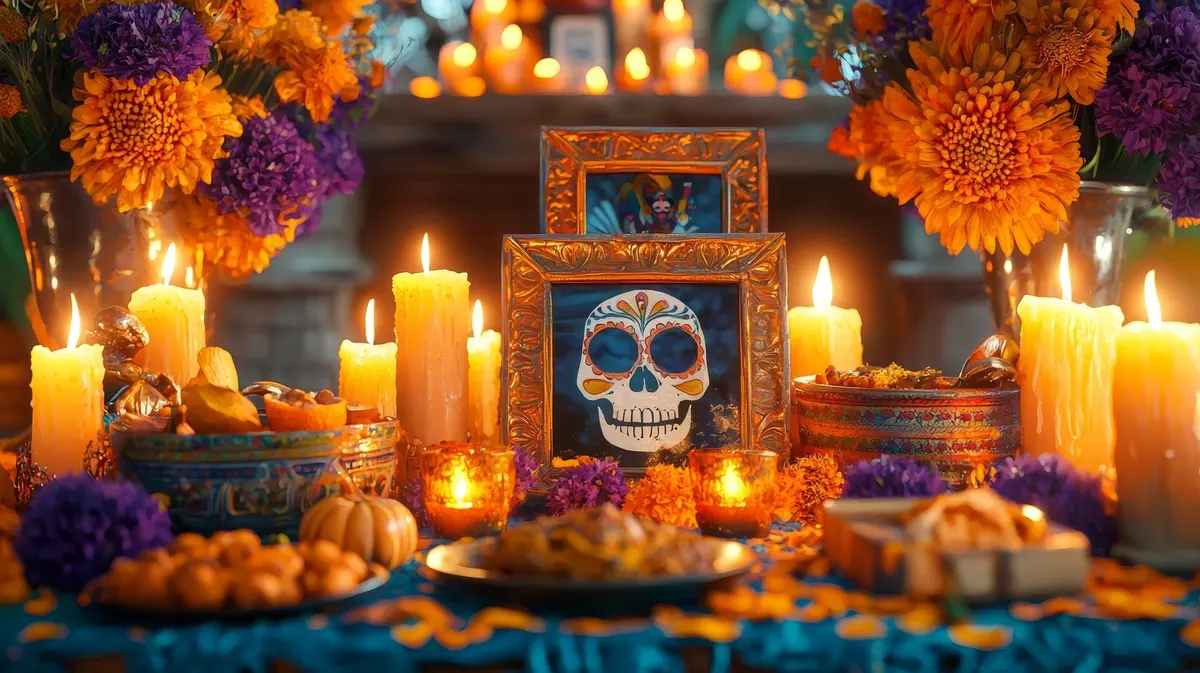
For many people living in the United States who keep a deep connection with their Hispanic roots, the ofrenda is not only a decorative altar put up in November. It is a living practice, a language between the visible world and the one that cannot be seen. If you got here looking for information about the ofrenda, something in your life has probably led you to wonder whether it can help you.
Maybe you lost someone important and feel that connection is not closed. Maybe you have spent weeks or months in a streak with no logical explanation: the business fell, the partner left, your health suffered without any doctor finding the cause. Maybe you feel a heaviness in your house, in your body or in your mood that you do not know how to name.
The ofrenda, understood in its broadest spiritual sense, can be a starting point. But before preparing one, it is worth understanding what it really is, what purpose it serves within the traditions of curanderismo, and when it makes sense to seek guidance from someone with true knowledge of these practices.
What is a spiritual ofrenda? Beyond the November altar
In the popular imagination, the ofrenda is almost always associated with the Day of the Dead: that colorful altar with cempasuchil flowers, photographs of the departed, food and candles that appears every first and second of November. That image is beautiful and real. But it is only one face of something much deeper.
In the Mesoamerican spiritual tradition, the ofrenda is an act of sacred communication. It is the way a human being builds a bridge between everyday reality and the forces, presences or energies that exist beyond what the eyes see. It is not a practice reserved for one date or one special occasion. Ofrendas are prepared when there is a concrete spiritual need: to honor, to ask, to give thanks, to protect oneself.
The word itself says it: ofrenda comes from ofrecer, to offer. It is a gesture of giving, of openness, of recognizing that there is something bigger than oneself that can be called on for support.
The roots of the ofrenda: an inheritance that came to stay
The practice of the ofrenda is one of the oldest and most persistent elements of the spiritual traditions of Mexico and Central America. Before the conquest, the Indigenous peoples made offerings to their deities, their ancestors and the forces of nature as part of a system of reciprocity: I give you something, you accompany me in what I need.
With colonization came Catholicism, and what happened was not a substitution but a fusion. Offerings for the dead mixed with the cult of the saints. Church candles entered the home altar alongside the images of the departed. Copal, the sacred incense of the original peoples, kept burning next to myrrh and Catholic incense. That is how the syncretic spirituality practiced today by millions of Mexican, Central American and Caribbean families was born.
That inheritance traveled with the migrants to the United States. In communities across Southern California, there are homes where an altar with a lit candle, a photograph and a glass of water is a permanent presence all year round. Because spiritual need has no calendar.
Types of ofrendas according to their spiritual purpose
Not all ofrendas are the same. Their purpose determines which elements they carry, how they are prepared and when they are made. These are the most common forms within Mexican curanderismo and the spiritual traditions of the region:
Ofrenda to honor the departed and keep the bond
This is the best known. It is prepared to keep alive the tie with those who have passed, to tell them they are not forgotten, to ask for their company or to close bonds left unresolved. Some people feel a persistent presence in the home, recurring dreams about a deceased relative or a sadness that does not lift. Preparing an ofrenda with the things that person loved can be the beginning of genuine closure.
Ofrenda to ask for protection or spiritual guidance
This one is addressed to the ancestors, to the saints of one's devotion or to the protective energies according to each family's tradition. It is prepared when someone feels unprotected, when there is a threat that cannot be seen but can be felt, or when something important is beginning and spiritual support is wanted. It usually comes with specific prayers and herbs with protective properties such as rue, rosemary or palo santo.
Ofrenda as part of a spiritual cleansing or protection work
Within curanderismo, the ofrenda can be the center of a more complex spiritual cleansing. The specialist prepares the altar to create a sacred space where the cleansing and protection work can be done with the necessary strength. In this context it is not only a symbolic gesture: it is part of the structure of the ritual itself. It can also accompany protection work for those facing active amarres, directed envy or intentional spiritual harm.
The elements of an ofrenda and what they stand for
Every object placed on an ofrenda has a meaning. It is not random decoration. In the tradition of Mexican curanderismo, these are the core elements:
- Candles: they stand for the light that guides, the fire that purifies and the presence of the sacred. Color has its own language: white for purity and protection, purple for contact with the departed, red for vital force.
- Water: symbolizes purity, life and the passage between worlds. A glass of clean water on the altar invites clean energies and makes room for the souls that visit.
- Copal or incense: the smoke carries the prayers upward. Copal has more than two thousand years of history as a purifier in the Mesoamerican traditions and is a central part of any authentic cleansing.
- Flowers: cempasuchil flowers are the ones most associated with the altar of the dead, but in general ofrendas white flowers are used, or the flowers of devotion of whoever prepares the sacred space.
- Photographs or images: they fix the intention. If the ofrenda is for a departed person, their photograph anchors them to the altar. If it is for a protective spiritual force, its image serves the same function.
- Food or drink: what the departed loved, or what is given as a gesture of love and reciprocity. The intention behind this gesture is what makes it sacred.
- Herbs: depending on the purpose of the altar, specific herbs are added: rue for protection, rosemary for cleansing, basil to draw in positive energy. Herbs are a pillar of curanderismo and their selection is not arbitrary.
An ofrenda does not have to be costly or elaborate to be genuine. What gives it strength is the intention, the faith and the care with which it is prepared.
Signs that something in your spiritual surroundings needs attention
Some people come to research the ofrenda after months of feeling that something is wrong without being able to name it. It is not suggestion or hypochondria: there are patterns spiritual specialists recognize as signs that a person's or a home's energetic surroundings need real attention.
Some of those signs are:
- Streaks of bad luck chained together with no explanation: accidents, financial losses, sudden conflicts with people close to you, all happening in a very short period.
- Repetitive disturbing dreams, especially if they involve deceased people or situations of pursuit.
- A persistent feeling of tiredness, heaviness or sadness that does not respond to rest and has no identifiable medical cause.
- Sudden conflicts with no apparent motive in relationships that used to be stable, including the unexplained withdrawal of a partner.
- Businesses or projects that collapse right when they seemed to be going well, with a frequency that does not answer to clear economic reasons.
- A feeling of being watched, of presences in the home, or of everyday situations with no rational explanation.
These signs, on their own, confirm nothing. Many hard situations have completely natural causes: accumulated stress, undiagnosed health problems, real financial difficulties. That is why it is important to tell apart what requires medical or psychological care from what may also have a spiritual dimension.
The rule is clear: if you have physical symptoms, see a doctor. If you have persistent anguish or sadness, seek emotional support as well. Spiritual work does not replace medicine. What it does is attend to a dimension conventional medicine does not cover.
What an ofrenda can and cannot do
Here it is worth being honest, because there is a lot of confusion about this, especially among people who did not grow up with these traditions openly.
An ofrenda can:
- Create a space of genuine connection with the ancestors and the spiritual energies that accompany a family.
- Be the beginning of a process of emotional and spiritual closure after a loss.
- Strengthen the protective energy of the home when it is prepared with clear intention and kept with continued respect.
- Be part of a broader practice that includes cleansings, prayers and sustained inner work.
- Give peace and a sense of support to whoever prepares it, which is not a minor or negligible effect.
An ofrenda cannot:
- Reverse deep spiritual harm on its own without the accompaniment of someone with real experience in curanderismo.
- Guarantee specific results within a set timeframe.
- Substitute for concrete action on the material plane: if there is a real financial problem, it also needs attention at that level.
- Undo active amarres or trabajos without a complete process of cleansing and protection afterward.
The curanderismo tradition is honest about this: spiritual work is discipline, consistency and faith. It is not a result that arrives overnight. Whoever promises that is not being honest with you.
The evil eye, envy and trabajos: when the ofrenda is not enough
There are situations where preparing an ofrenda at home can be the start of something, but is not enough on its own. This happens especially when there is suspicion of intentional spiritual harm: evil eye, active envy or work done by someone with intent to cause harm.
The evil eye in the Hispanic tradition is not only a cultural belief. It is the recognition that a gaze loaded with envy or an intense desire can affect a person's energy, especially a child's. Its most common signs are crying without cause in babies, sudden tiredness after being in crowded places, or headaches and diffuse discomfort that appear after public exposure or a visible achievement.
Trabajos, on the other hand, are intentional spiritual interventions done to harm another person: to drive a partner away, to ruin a business, to create confusion or sustained bad luck. Recognizing whether there is an active trabajo requires experience, because its effects are easily confused with problems that look ordinary.
When there is suspicion of intentional spiritual harm, the ofrenda can be part of the answer, but generally a complete spiritual cleansing is needed: specific prayers, purifying herbs and protection work afterward that seals the road that harm came in by. That requires the accompaniment of someone with genuine knowledge of these traditions.
How to prepare a basic ofrenda at home
If you want to start with something simple, you need nothing costly or elaborate. What matters most is the intention with which you do it.
Choose a quiet space in your home: a shelf, a corner of a room, a small table. Clean it well, both physically and with a little copal or incense to purify the atmosphere before placing anything.
First lay down a clean cloth, preferably white. Then place the elements according to your intention: a photograph if the ofrenda is for a departed person, or an image of your devotion if it is to ask for guidance or protection. A glass of fresh water. A lit candle. Flowers if you have them. Herbs such as rue or rosemary if you are seeking protection.
When you light the candle, do it calmly. Say out loud or in your mind who this ofrenda is for and what you are asking for or giving thanks for. The prayers you have known since childhood, the ones your mother or grandmother taught you, have value. Clear intention and faith are the most important ingredients of any ofrenda.
Keep the altar clean and the water fresh. A neglected ofrenda loses its strength. If you cannot keep it up, it is better to ask for guidance before starting.
Frequently asked questions
Is an ofrenda the same as an altar?
In everyday use both words are interchangeable, but there is a difference in nuance. The altar is the physical space: the shelf, the table, the dedicated place. The ofrenda is the set of elements placed on that altar with a specific spiritual intention. Put another way: the altar is the container, the ofrenda is what is placed in it with faith.
Can I make an ofrenda if I am not a practicing believer?
The ofrenda is not reserved for those who practice a religion formally. It is a cultural and spiritual practice many people carry out from personal faith, without belonging to any religious institution. What it does require is respect and genuine intention. Preparing it as a purely decorative gesture, with no real intention, can make it useless. But it does no harm.
How long should the candle stay lit?
It depends on the purpose and the tradition you follow. In everyday ofrendas, many families light the candle while they are home and put it out before sleeping or going out. In specific curanderismo rituals it can stay lit throughout the work. If you have doubts, a specialist can guide you according to the nature of what you are living through.
Why is water placed on the ofrenda?
Water stands for purity, life and communication with the spiritual world. In the Day of the Dead tradition, the visiting souls are believed to arrive thirsty from the road. But beyond that date, clean water keeps the energy of the space healthy. Changing it regularly for fresh water is part of maintaining any active altar.
Can an ofrenda help if I suspect someone did work or witchcraft on me?
A protection ofrenda prepared with the right elements, proper prayers and specific herbs can be part of the answer. But when there is suspicion of intentional spiritual harm, a more complete process is generally needed: a cleansing, protection work and closing the road that harm came in by. That requires the accompaniment of someone with real experience in curanderismo.
What do I do if I feel the ofrenda I prepared is not working?
First, give it time. Spiritual changes are not measured in days. Second, check whether you prepared it with genuine intention or mechanically. Third, consider whether what you are living through also has a concrete cause that requires attention on the material plane. If after all this you still feel something is wrong and what you prepared is not enough, that is the moment to seek guidance from someone with real knowledge.
Can the ofrenda protect my home from envy and negative energies?
A protection ofrenda prepared with white candles, herbs such as rue and prayers of safekeeping can help clean and strengthen the energy of a home. It is not an instant or permanent barrier without maintenance. But sustained with faith and consistency, it creates a healthier spiritual environment, less permeable to envy and to the negative energies that come from outside.
When to seek guidance from a specialist
There are moments when the ofrenda you can prepare at home, however sincere, is not enough for what you need. When you have spent weeks or months in a situation that does not let up, when you feel the harm is deep or intentional, when the signs pile up and no conventional explanation resolves them: that is the moment to find someone with genuine knowledge of these traditions.
Don Jacinto Nahual is a curandero from Catemaco, Veracruz, one of the regions of Mexico with the deepest and most recognized spiritual heritage in the country. With more than 30 years of practice and knowledge passed down through generations, he accompanies people going through situations like the ones described in these pages: streaks that do not let up, suspicions of spiritual harm, the need for real protection, cleansing processes that require more than a candle lit at home. He works in English and Spanish.
He sees people in person by appointment in Los Angeles and other Southern California communities such as Huntington Park and Long Beach. For those who cannot come right away, he also offers initial guidance by call or message to understand the case before any work.
His philosophy is the same as the tradition that formed him: spiritual work is discipline, faith and strengthening of the spirit. He does not promise instant results or guarantees no honest curandero can give. What he does offer is presence, knowledge and genuine accompaniment. Because a well-prepared ofrenda, in the right context and with proper guidance, can be the first step toward a different road.