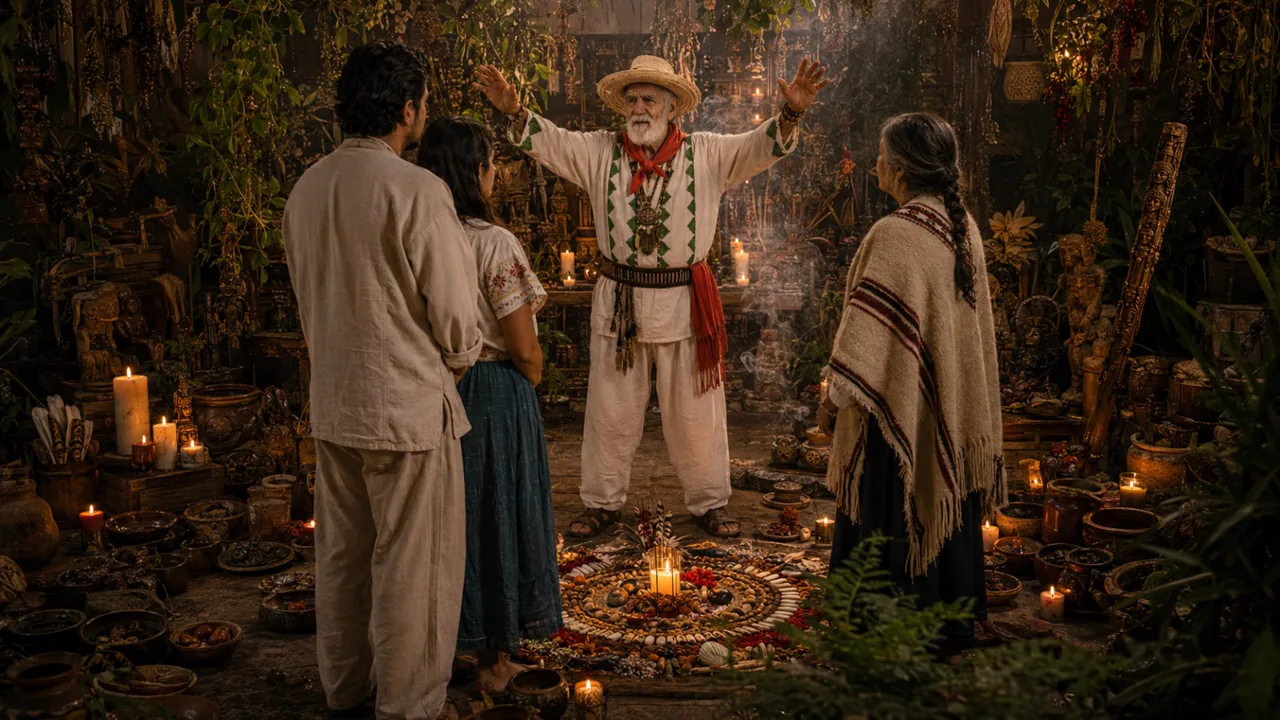
A bruja is a person who works with spiritual forces to cause an effect in the world: protect, attract, cut, harm. The word does not say whether what she does is good or bad. That depends on the intention of the one practicing it, and that distinction is the one almost nobody makes.
In Mexico the word carries centuries of history. In the United States, for anyone who grew up here, "witch" means something else: pointed hat, Halloween, Salem. That is why so many Hispanic people in California search for "bruja" on Google and land on pages that have nothing to do with what they are looking for.
I am Don Jacinto Nahual. I come from the curandero tradition of Catemaco, Veracruz, I inherited it from four generations of my family and I have been at this for more than thirty years. I am going to explain the differences without ornament, because most of the people who call me for the first time do not know who they are calling or what to ask for.
Where the word comes from
"Bruja" is an old Castilian word, older than the arrival of the Spanish in the Americas. In medieval Europe it named the woman accused of making a pact with the devil, and it crossed the Atlantic with that weight. Here it mixed with something different: the Indigenous curanderas, the midwives, the herb women, the women who knew about plants and births and sustos.
The Inquisition put them all in the same sack. Healing with herbs and doing harm with intention were, on the papers of the time, the same crime. And the habit of confusing them stayed stuck to the language until today.
That is why in many regions of Mexico, and Veracruz is one of them, calling someone "bruja" or "brujo" is not an insult. It is a title, almost a trade. It is said with respect and sometimes with fear, which in these matters go together.
Bruja, curandera, hechicera, santera: what each one does
These four words are used as if they were synonyms and they are not. The confusion makes people ask for what they do not need, or pay for something the person in front of them does not know how to do.
- Curandera or curandero. Works on the health of the body and the spirit with herbs, prayers, cleansings and sobadas. The trade is to remove, not to put on: susto, evil eye, empacho, heaviness. Not a doctor and should not present as one.
- Bruja or brujo. A broader term. It includes what the curandero does and also work with intention aimed at another person: protecting someone, attracting, cutting a harm, and also causing it. A serious brujo tells you what he agrees to do and what he does not.
- Hechicera or hechicero. Focuses on the hechizo, the spell, the specific piece of work for a concrete purpose. An amarre, an opening of roads, a protection. It is more a kind of work than a complete tradition.
- Santera or santero. A person initiated in the Regla de Ocha, Santeria, a religion of Yoruba origin born in Cuba. It requires formal initiation, a godparent and ceremonies. It is a religion, not a service.
I am not a santero or a babalawo. If what you need is an asiento de santo or a caracol consultation, there are people who do that seriously in Los Angeles and the right thing is for you to go to them. Mine is the Catemaco tradition, which works with Catholic saints, with herbs and with candles, and which shares exactly that with Santeria: the dealing with the saint.
White magic and black magic: why that division is simpler than it looks
Almost everyone arrives asking whether what is going to be done is white magic or black magic, as if they were two separate drawers. In practice it does not work that way.
What separates one piece of work from another is who it is aimed at and with what intention. A protection that shields your house and one that returns the harm to whoever sent it use the same herbs and the same prayers. The recipient changes. And that, more than the color, is where I draw the line.
My opinion, and I have thirty years to back it: work done to harm someone ends up turning against the one who asked for it. I do not say it out of morality. I say it because I have seen people come into my office to fix the disaster they themselves ordered, and undoing it costs more than avoiding it would have.
How to know if the person in front of you is serious
This is the part nobody tells you for free, so here it is in full.
- He asks you questions before offering you anything. If in the first two minutes he is already quoting a price, bad sign.
- He tells you what he cannot do. Whoever can do everything can do nothing.
- He gives you a fixed price for the first piece of work. The ones who start cheap and keep raising it "because the energy is very heavy" live off that.
- He does not scare you. The threat of a curse only that person can remove is the oldest trick in the trade.
- He has a physical place to see people, not just a phone number.
- He does not ask you to stop your medical treatment. Never. If he asks that, walk out.
And a limit that also has to be said: not everything that hurts is spiritual. Some of the people who call me need a doctor or need a psychologist, and when I see it I tell them, even if that means they do not come back.
When people look for a bruja or a brujo
The reasons repeat. I have spent three decades hearing them and they are almost always these.
- A partner who left from one day to the next, with no fight and no explanation.
- A discomfort in the body that doctors cannot find after several tests.
- A streak where everything falls at once: work, money, health, family.
- The feeling that someone close wishes you harm. Envy has a first and last name in most cases.
- Repeated dreams with the same person or the same scene.
If any of this is happening to you, the first thing is not a piece of work. It is a spiritual cleansing, which is what shows what is there before deciding anything. It is like a lab test: first you look, then you treat.
Frequently asked questions
Are bruja and curandera the same thing?
No. The curandera heals and removes. The bruja does that and also works with intention aimed at another person. In everyday speech in many parts of Mexico they are used interchangeably, but the trade is not the same.
Does being a bruja go against the Catholic religion?
The Church condemns it. In practice, the Catemaco tradition prays to Catholic saints, uses holy water and works with the same calendar of saints. Millions of people in Mexico live both things without conflict, and it is not my place to settle that for them.
How much does a consultation cost?
The first cleansing with me costs $97 and lasts about an hour. Almost nobody finishes in one: three sessions is normal, and in heavy cases it can be up to nine. I tell you before, not after.
Can it be done at a distance?
Part of the work, yes. The first time I prefer to see the person's face, because there are things you cannot detect over the phone.
Where I see people
I have two offices in Southern California. In Los Angeles, at 1208 Venice Blvd. In Santa Ana, at 830 S Main St Ste 109, and that one is by appointment only because it is an inside office and there is nobody at reception. I work in English and Spanish.
If you want to talk before deciding, the phone number is (213) 598-1928. That call costs nothing and in five minutes we will know whether yours is something I see or something someone else sees.