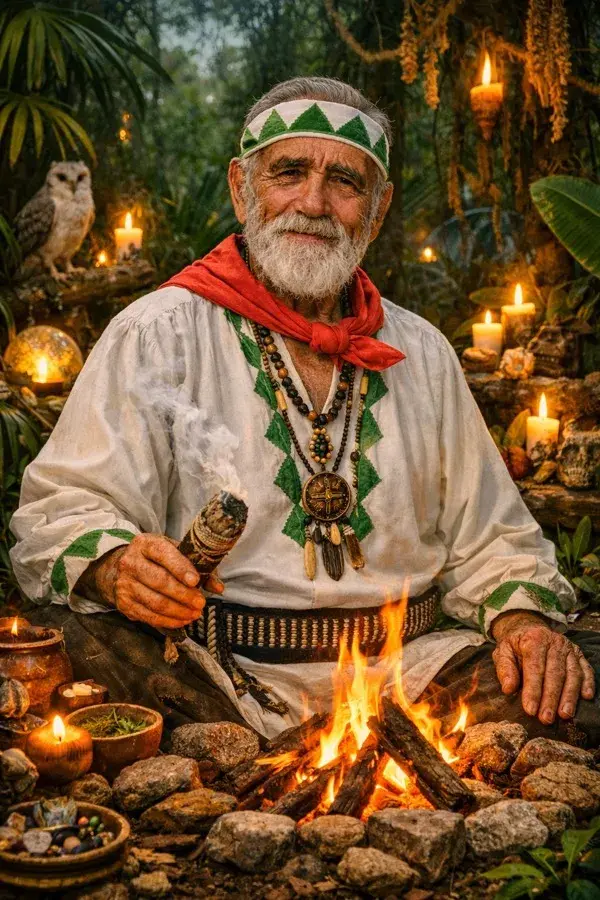
A curandero is a traditional healer. The work covers the body and the spirit at once, using herbs, prayer, cleansings and hands-on massage, and it is passed down inside families rather than taught in a school. A curandero is not a doctor and should never present as one.
In Mexico and across Southern California people go to one when the trouble does not fit a diagnosis. That is the honest description of who walks through my door: someone who already tried the other doors.
What the practice actually covers
- Susto. Fright that lodges in a person after an accident, a death, a deportation, a violent scene. Common in children.
- Mal de ojo. The evil eye, which in this tradition means harm carried by someone else's envy or intense attention.
- Empacho. A blockage in the stomach, treated with massage and herbs.
- Limpias. Cleansings, the core of the work. Herbs, egg, copal, prayer.
- Reading what a person carries. Cards, the egg in water, or simply listening carefully to someone who has not been listened to in a long time.
The word carries no gender rule. A woman doing the same work is a curandera, and in most of Mexico there have always been more of them than of us.
Curandero, brujo, santero: not the same thing
People use these interchangeably and then ask for what they do not need.
A curandero heals and removes. A brujo does that and also works with intention directed at another person, to protect, to attract, to cut. A santero is initiated in Regla de Ocha, the Cuban Yoruba religion, which requires formal initiation and a godparent. That last one is a religion, not a service.
I am not a santero and not a babalawo. If what you need is a reading with the shells or an initiation, there are people in Los Angeles who do that properly and you should go to them. What I have is the tradition of Catemaco, Veracruz, which works with Catholic saints, herbs and candle.
Six ways to tell a serious one from a fraud
- They ask before they offer anything.
- They tell you plainly what they cannot do.
- They give a closed price for the first session instead of an open tab.
- They do not frighten you with a curse only they can lift.
- They have a physical office you can walk into.
- They never tell you to stop a medical treatment.
That fourth one is where most of the money in this trade is made, and it is worth saying twice. If the conversation starts with what will happen to you unless you pay, you are being worked.
When you should see a doctor instead
Chest pain, a lump, unexplained weight loss, a fever that will not break: those are a physician, today. Months of sleeplessness and hopelessness is a therapist. Thoughts of hurting yourself are an emergency, and the number is 988.
I turn people away for this every month and I would rather keep doing that than take money from someone who needed an ambulance. That is my opinion after thirty years, and not everyone in this trade shares it.
Common questions
How much does it cost?
A first cleansing with me is $97 and lasts about an hour. Three sessions is the usual course; heavy cases can run to nine. You hear that before you pay, not after.
Do I have to speak Spanish?
No. I work in both languages every week.
Is this against my religion?
The Catemaco tradition prays to Catholic saints and uses holy water. Whether that sits well with your own faith is yours to decide, and I am not going to argue you into it.
Where I see people
Los Angeles, 1208 Venice Blvd. Santa Ana, 830 S Main St Ste 109, appointment only. Four generations of curanderos behind me and over thirty years of my own.
(213) 598-1928. The first call is free. If you want the groundwork first, start with what a spiritual cleansing is.