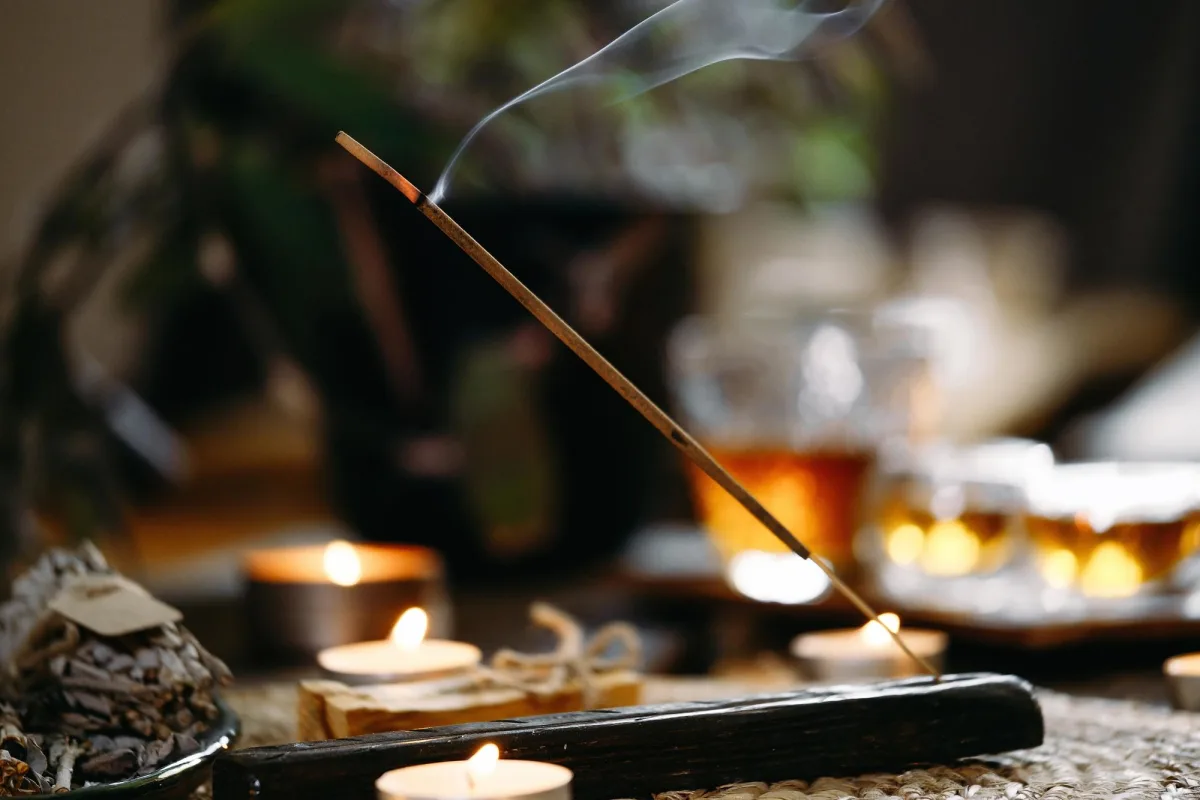
There are moments when the body warns before the mind understands. A heaviness that cannot be explained. Sleepless nights with no apparent reason. The feeling that something went wrong in life, at work, in love, in health, and you cannot find the cause. If you came looking for information about the sahumerio, the Hispanic practice of smudging, you probably did not get here out of simple curiosity. You got here because something needs to change and you are looking for guidance. This article is written to help you understand what a sahumerio really is, when it makes sense to use it, and what you should know before doing so.
What a sahumerio is and why so many people look for it
A sahumerio is a spiritual practice that consists of burning herbs, resins or incense to purify a space, a person or a situation. The word comes from the Latin suffumigare, "to fill with smoke from below". In the spiritual traditions of Mexico, the Caribbean and Central America, the sahumerio is not a decorative ritual; it is a tool of spiritual work with very concrete purposes.
Some people come looking into the sahumerio after months of feeling that life does not flow. Businesses that fall with no logical explanation. Relationships that break from one day to the next. Physical discomfort the doctor cannot clearly diagnose. Not all of those situations have a spiritual cause, but when medicine, therapy and your own effort are not enough, it is natural to look for another kind of answer.
In that context, the sahumerio is a way to begin a process of energetic cleansing and protection. It is not instant magic. It is not a shortcut. It is an act of intention and faith that, within the Hispanic spiritual worldview, has real effects on the energetic field of a person or a place.
The sahumerio in the Hispanic spiritual tradition
In the Mexican tradition, the use of copal as a sahumerio has pre-Hispanic roots that predate Christianity by centuries. The Nahua, Maya and Zapotec peoples used copal in ceremonies of communion with the sacred, to cleanse the sick, to open roads before important decisions and to protect homes from negative influences.
With the arrival of Catholicism, the sahumerio did not disappear; it merged. Today, in many Hispanic communities in the United States, copal and herbs coexist with the rosary, the candles and the prayers. Mexican curanderismo, which is the basis of many spiritual practices in the Hispanic community, integrates the sahumerio as a fundamental part of cleansings.
In the Caribbean tradition, especially in Cuba and Puerto Rico, Santeria and spiritism also have their own versions of the sahumerio. The herbs change, the rituals vary, but the central purpose is the same: to move stagnant energy, cut ties with what harms, and make way for what heals.
What the sahumerio is really for
Before talking about the uses of the sahumerio, it is worth starting from a fundamental point: within the Hispanic spiritual worldview, we are more than body and mind. We are also an energetic field, a field that can accumulate burdens, interference and blocks that do not respond to conventional treatment.
The sahumerio acts on that field. Its main functions are several.
As a tool for spiritual cleansing
The spiritual cleansing, the limpia, is one of the most common pieces of work in curanderismo. It consists of removing dense energy, accumulated fears, unwanted presences or burdens a person has picked up over time. The sahumerio is a central part of that process.
When someone goes through grief, betrayal, financial loss or a long illness, they can be left with an energetic burden the body does not process on its own. The combination of smoke, specific herbs, prayers and the curandero\'s intention creates the conditions for that burden to move and for the body to return to its natural state.
For protection and cutting harmful ties
Another use of the sahumerio is energetic protection. There are homes where the atmosphere feels heavy with no obvious reason. There are people who feel someone wishes them harm, whether out of envy, resentment or conscious intention. A sahumerio with protective herbs such as rue, rosemary or copal creates a barrier that, within spiritual practice, makes it harder for those energies to settle.
It is also used to cut ties with people or situations that drain energy. It is not about harming anyone. It is a declaration of intention: that what no longer serves, what should no longer be there, leaves.
The types of sahumerio most used in the Hispanic tradition
Before choosing a sahumerio, it helps to understand that not all herbs or resins have the same purpose. Each carries an intention, and that intention determines what is used and when. The most common in the Hispanic tradition are these:
- White copal: deep purification, communication with the sacred. It is the most traditional in Mexican practice and the one most used in ceremonial cleansings.
- Rue: protection against the evil eye and envy. Especially recommended after visiting crowded places or after conflicts with third parties.
- Rosemary: cleansing of the home, removal of residual energy from fights or hard moments within the family space.
- Palo santo: harmonizing the atmosphere and attracting favorable energy. Its use has spread widely in Hispanic communities in California in recent years.
- Myrrh incense: intense spiritual protection, especially when placed work or deliberate outside intentions are suspected.
- White sage: general cleansing of the home, very accessible and widely used in Hispanic communities in the United States as a first step before a deeper cleansing.
The right sahumerio depends on the concrete situation. Someone who feels envy over their business does not need the same as someone who just left a toxic relationship. That reading, which herb, which prayer, which moment, is part of the knowledge a specialist with years of real practice has.
Signs that more than tiredness is going on
One of the hardest questions to answer is this: is what I feel a spiritual problem, or something that resolves with rest, therapy or a change of habits?
There is no universal answer. But there are patterns that, within curanderismo and Hispanic spiritual practice, are associated with imbalances that go beyond the physical or emotional. Some of them are:
- A constant feeling of heaviness with no diagnosed physical cause, persisting for weeks or months.
- A bad streak that spreads across several areas at once: work, money, health, relationships, all at the same time.
- Repetitive disturbing dreams, especially with deceased people or threatening situations that repeat faithfully.
- The feeling of being watched, or of presences in the home, especially at night or in certain parts of the house.
- Abrupt mood changes with no clear trigger, extreme irritability or deep sadness that does not respond to conventional treatment.
- Sudden loss of business or of opportunities that seemed secure, with no clear rational explanation.
- Unexplained distancing of people close to you, partner, children, partners, in a short period of time.
These signs are not a diagnosis. They do not replace medical or psychological evaluation. But they are signs that, in many Hispanic families, have been recognized for generations as possible clues that something spiritual needs attention.
The difference between a spiritual problem and one that needs another kind of help
One of the things that sets a good curandero apart from one who only charges is precisely this: knowing how to tell what kind of help the person who arrives needs. Not everything is spiritual. Not everything resolves with a sahumerio or a cleansing.
If a person has physical pain, the first step is always the doctor. If they are going through severe depression, the first step is the psychologist or the psychiatrist. Spiritual work does not compete with medicine; in the tradition of genuine curanderismo, both coexist. A good spiritual specialist will not ask you to abandon your medical treatment. If someone does, that is a serious warning sign.
The sahumerio and the spiritual cleansing are complementary tools. They can support a process of emotional healing, help restore the energetic balance of a home, accompany someone through hard grief. But they do not replace professional care when that care is necessary.
The key distinction is this: if after weeks or months of conventional treatment the problem persists, or if it affects several areas of life at the same time with no clear rational explanation, then it may make sense to complement with spiritual work. That decision is always the person\'s, informed, not pressured.
Common mistakes when doing a sahumerio at home
Many people try to do a sahumerio on their own after watching tutorials on social media. There is nothing wrong with wanting to cleanse your space with smoke and intention. But there are frequent mistakes worth knowing before you start:
- Using any herb without knowing its purpose: not all herbs cleanse. Some are for attraction, others for protection, others for cutting ties. Mixing them without knowledge can be ineffective or simply have no real effect.
- Doing the sahumerio with no clear intention: smoke alone is smoke. What turns it into a spiritual tool is the intention, the prayer and the knowledge of the person doing it. Without that, it is aromatherapy, not a spiritual cleansing.
- Keeping the space completely closed: the sahumerio displaces energy. If there is no way out, that energy has nowhere to go. A window or door should always be opened during the process.
- Doing it at the wrong moment: in the spiritual tradition there are more favorable moments for certain work. Doing a cleansing in the middle of an active conflict, for example, may not have the expected effect.
- Expecting immediate results: spiritual work acts in layers. A sahumerio can be the start of a process that takes time, not the switch that turns a problem off at once.
Understanding this does not mean you cannot do a sahumerio at home. It means doing it well, with real knowledge, is different from following a three-minute video online.
The sahumerio as part of wider spiritual work
In the practice of curanderismo and in the more serious Hispanic spiritual traditions, the sahumerio is rarely the only element of a piece of work. It is part of a process that can include specific prayers, herbs for spiritual baths, candle vigils and, in some cases, identifying whether there are amarres, work against you or active envy that needs to be addressed at the root.
When someone comes to a curandero after months of a bad streak, the specialist first listens. Then he reads the situation, which may be through the cards, tobacco, the egg or other methods of spiritual diagnosis each tradition recognizes. From there, the kind of work needed is defined.
The sahumerio can be the first step, clearing the field before working what lies underneath. Or it can be a close, sealing after something deeper was done. Either way, it is not improvised. It has a logic, a sequence, a specific purpose.
A sahumerio bought at an herb shop and burned without guidance is not the same as a cleansing led by someone who has spent decades learning this trade from those who knew it before him.
Common questions
Is the sahumerio compatible with being Catholic?
Yes, for most people in the Hispanic tradition there is no contradiction. In Catholicism, incense has been part of the Mass for centuries. In Mexican curanderismo, the spiritual and the religious have been naturally woven together for generations. Many people who practice the sahumerio identify as practicing Catholics, pray the rosary and at the same time use copal or rue to cleanse their home. Faith and spiritual tradition do not exclude each other; they complement each other.
Can I do a sahumerio in my apartment if I have no yard?
Yes, with precautions. The most important thing is to ensure ventilation: open windows and, if possible, a door. Use small amounts of herb or resin so as not to produce too much smoke in small spaces. And check that the building does not have sensitive smoke detectors that could go off unnecessarily. With those basic precautions, an indoor space is perfectly suitable.
How often does it make sense to do a sahumerio?
It depends on the purpose. A maintenance sahumerio, to keep the home\'s atmosphere clean and harmonious, can be done once a week or every two weeks. A deep-cleansing sahumerio, after a hard event, can be done for several days in a row as part of a process. A specific protection sahumerio can be done when there are signs of energetic tension or when someone feels they have been exposed to a lot of other people\'s burden. A specialist can guide you better according to what you are living.
How do I know if the sahumerio I did worked?
The results of a sahumerio are not always immediate or dramatic. Sometimes they show as a feeling of relief or lightness right after the practice. Other times as a dream that lets you process something that was emotionally stuck. And other times the changes become evident days or weeks later, when the situation begins to move in ways that seemed impossible before. The absence of an immediate dramatic result does not mean it did not work.
Does the sahumerio work for the evil eye?
The evil eye is one of the most recognized spiritual ailments in the Hispanic community, especially in children and energetically sensitive people. A sahumerio with rue or white copal is a commonly used tool to treat it, especially combined with egg cleansings, specific prayers and protective herbs. If the symptoms are severe or have gone on without easing, the best advice is to seek someone with real experience in this kind of work, not to stay with the home sahumerio alone.
What do I do if I suspect someone did work against me?
When someone suspects there is work against them, spells, amarres, envy with deliberate intention, the sahumerio can be a first line of protection and cleansing of the personal field. But if the situation is serious and the symptoms persist, a home sahumerio will hardly be enough to undo something done with knowledge and deep intention. In those cases, the honest thing is to seek a specialist who can make a real diagnosis before acting, instead of trying to resolve something bigger with tools that are not enough for it.
Is it dangerous to do a sahumerio wrong?
A badly done sahumerio, in the worst case, simply does not have the desired effect. For spiritual work to have negative consequences, much more is needed than burning the wrong herb. What is worth avoiding is combining practices from very different traditions without understanding what you are doing; mixing rituals without knowledge is not dangerous in itself, but it can create energetic confusion and leave the situation the same or more tangled than it was.
When to seek guidance from a specialist
There are situations that do not resolve with information or with your own attempts. When life has become hard in several areas at the same time, when the bad streak stretches beyond what is reasonable, when there are signs pointing to something outside the everyday, in those moments it can help to talk with someone who really knows what they are looking at.
Don Jacinto Nahual is a curandero from Catemaco, Veracruz, a region recognized for its deep spiritual heritage. With over 30 years of practice and knowledge passed down through generations, he sees people in Southern California looking for genuine spiritual guidance, not empty promises or overnight magic solutions.
His work includes cleansings with herbs and prayers, spiritual guidance, energetic protection and harmonizing of the home and business environment. He sees people in Los Angeles, Long Beach and Inglewood, as well as other communities in Southern California, in person by appointment. He also offers initial guidance by call or message for those who cannot travel or prefer a first conversation before booking. He works in English and Spanish.
His philosophy is clear and does not change: spiritual work is discipline, faith and strengthening of the spirit. There are no overnight results, no guarantees anyone should believe, and no shortcuts worth taking. What there is, is honest accompaniment for whoever is willing to work on their own process.
If what you read in this article resonates with what you are living, and you feel the sahumerio and spiritual work can be part of the guidance you need, the most sensible first step is exactly that: a call, a message, an honest conversation. That is where it starts.